
1 · Intake
Counterparty paper
MSA, NDA, employment offer, scanned bundle. Landed at /contract. The clock starts.
Klauz reads counterparty paper, returns a clean redline with rationale in the margin, keeps every matter's memory and audit trail, and routes the serious questions to a licensed specialist. A live workbench, not a slide.
MSA, NDA, employment offer, scanned bundle. Landed at /contract. The clock starts.
Parties, term, liability, termination, payment, obligations, playbook deviations. Eleven section buckets.
Counsel reviews the diff, not the document. Every clause carries its fallback and the reason it was chosen.
Documents, decisions, timeline, and audit stay attached to the matter. Nothing scattered in Drive.
Serious matters route to licensed specialists from $250 a matter. The two-sided network compounds.
Every clause, change, model call, and signature carries a tamper-evident record. KLZ-YYYYMMDD-HHHHHH on every page.
The six moves sit on eight capabilities, each one live and wired. This is the full surface a counsel touches, not a demo path.
Counterparty paper (MSA, NDA, SLA, employment offer, scanned bundle) is read across eleven section buckets: parties, term, liability, indemnity, IP, payment, termination, and the rest. Each clause is tagged, risk-scored, and traced back to the page it came from. India-specific gaps surface by name: a missing data-protection clause, an absent GST or stamp-duty treatment, no seat of arbitration, uncapped liability, an auto-renewal that renews against the reader.
Bail applications, legal notices, and petitions come out in the form an Indian court accepts: the heading, MOST RESPECTFULLY SHOWETH, numbered grounds, the prayer, the verification, the annexure list. The reader gets two copies of every draft: the court-filing copy and a review copy that carries a KLZ authenticity ID keyed to the draft.
A scanned FIR, a judgment, a chargesheet, a bilingual Hindi and English bundle is read in full, not skimmed at the top. The reader decides what the document actually is before it extracts anything, so a policy report is never mistaken for a first information report, and a document title is never mistaken for a judge. Every person, section, date, and citation it returns must trace to the source text; whatever cannot is dropped and listed.
Case-law search runs as a pipeline: read the intent, break the question into sub-queries, retrieve, then rank. Authority is drawn from a curated corpus rather than generated, and any citation that reaches a draft is checked before it is shown. An unverified or repealed reference is marked as such, never dressed up as good law.
The 2023 criminal-law overhaul is native. Old Penal Code sections map to their Bharatiya Nyaya Sanhita equivalents, and the reader applies the new codes to conduct after 1 July 2024 and the old codes to earlier conduct, flagging the bridge where it matters. Counsel does not keep a conversion chart open in another tab.
A case can start from a dictated note or a message to the Klauz number. Send the facts, or a voice note, and a court-format draft comes back. The channel runs online with no dependency on any one laptop being awake, so intake does not stop when the office closes.
Documents, decisions, the timeline, and the audit trail stay attached to the matter instead of scattered across drives and inboxes. Every clause touched, every reasoning call, every specialist minute lands in a ledger the firm can read. This is the company legal brain, and it is auditable by construction.
When a matter is serious enough to need a licensed specialist, it routes to one from a defined rate. The workbench does the first eighty percent so the specialist spends their hour on judgement, not on reading the file from scratch. The two-sided network compounds as more firms and more specialists join.
Each frame below is a screen counsel actually sees. The annotations at the margin are the ones the workbench itself surfaces.
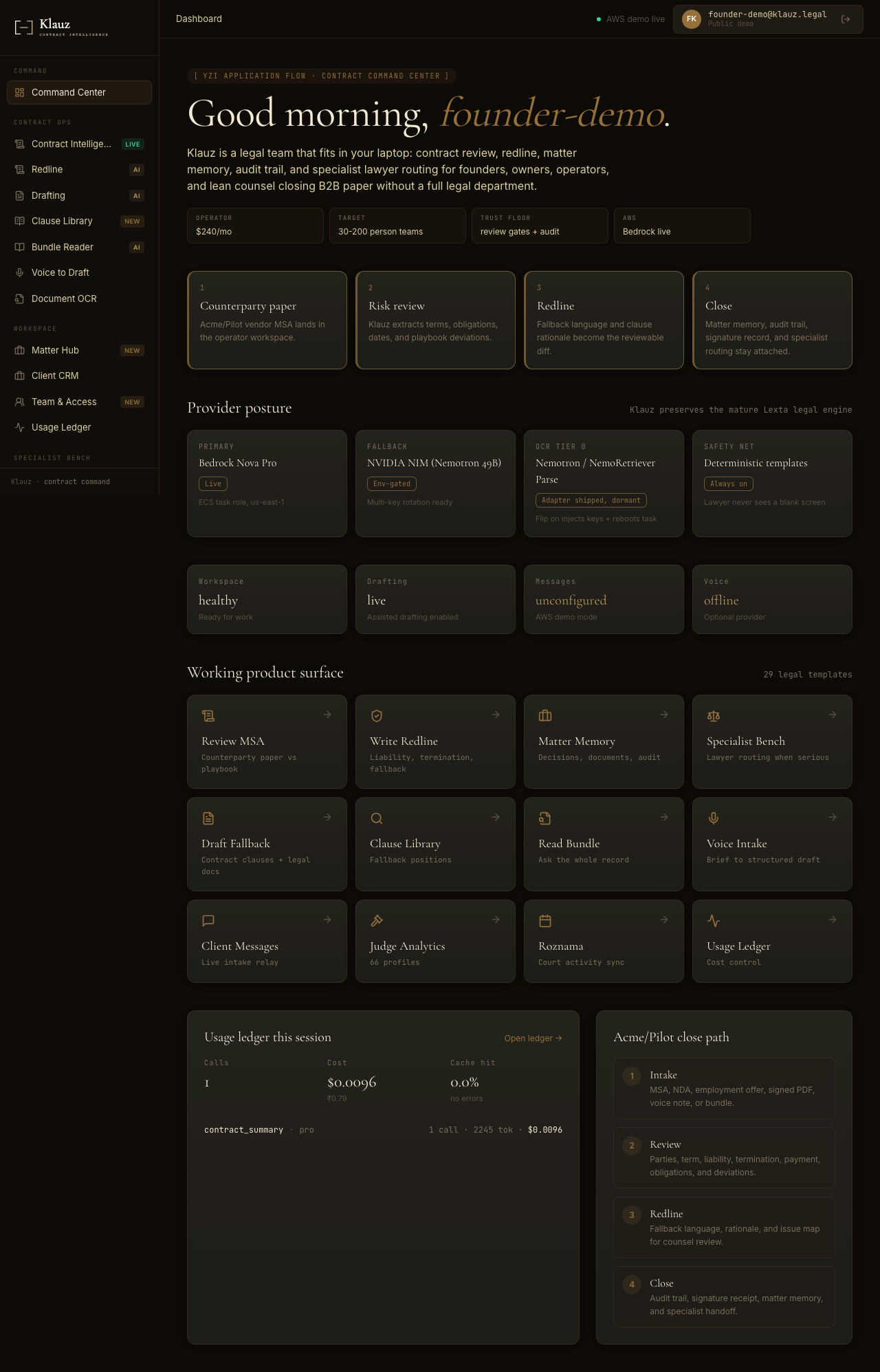
The dashboard shows the matters in flight and the reasoning posture live. Primary lane live, secondary lane on standby, deterministic templates always on. Counsel never lands on a blank screen.

Eleven section buckets. Parties, term, liability, indemnity, IP, payment, termination. Every clause is tagged, scored, and traced back to the exact page in the source PDF.
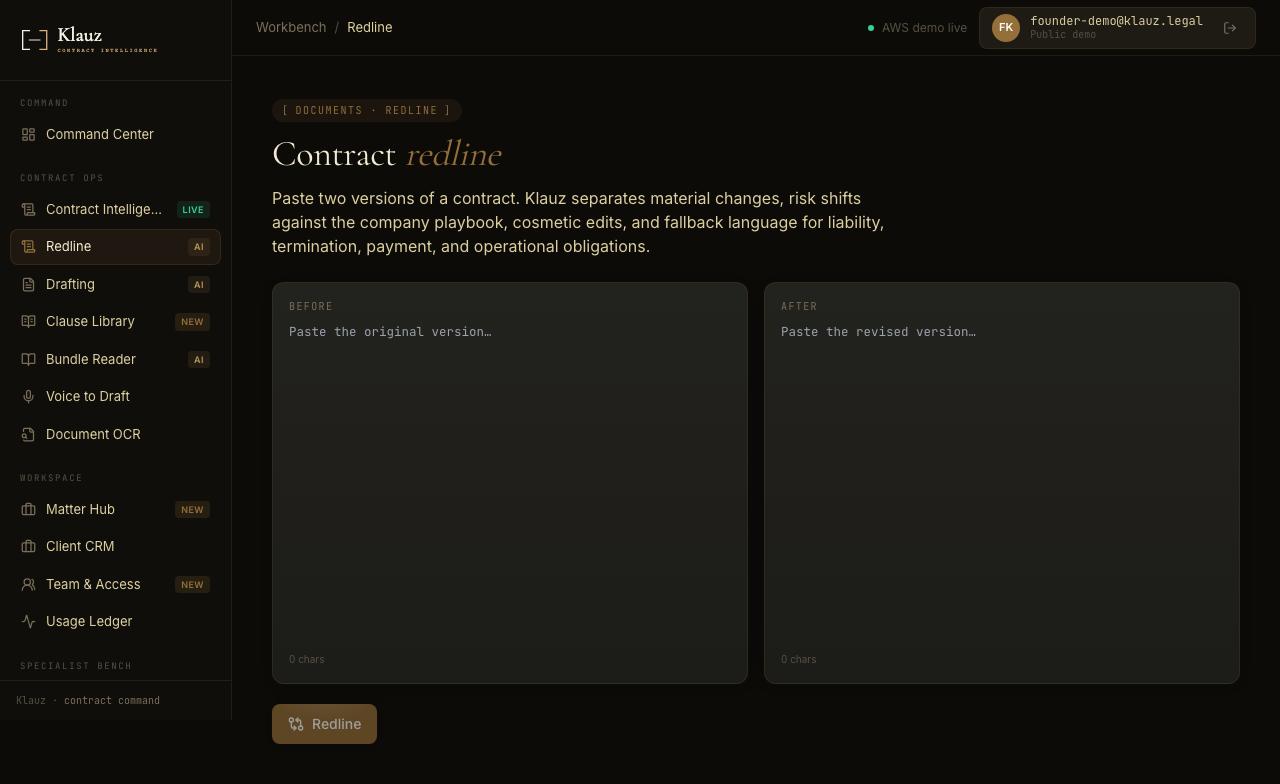
Counsel reviews the diff, not the document. Each proposed change carries the fallback drawn from playbook precedent and the reason it was proposed. A junior lawyer's afternoon collapses into a morning.
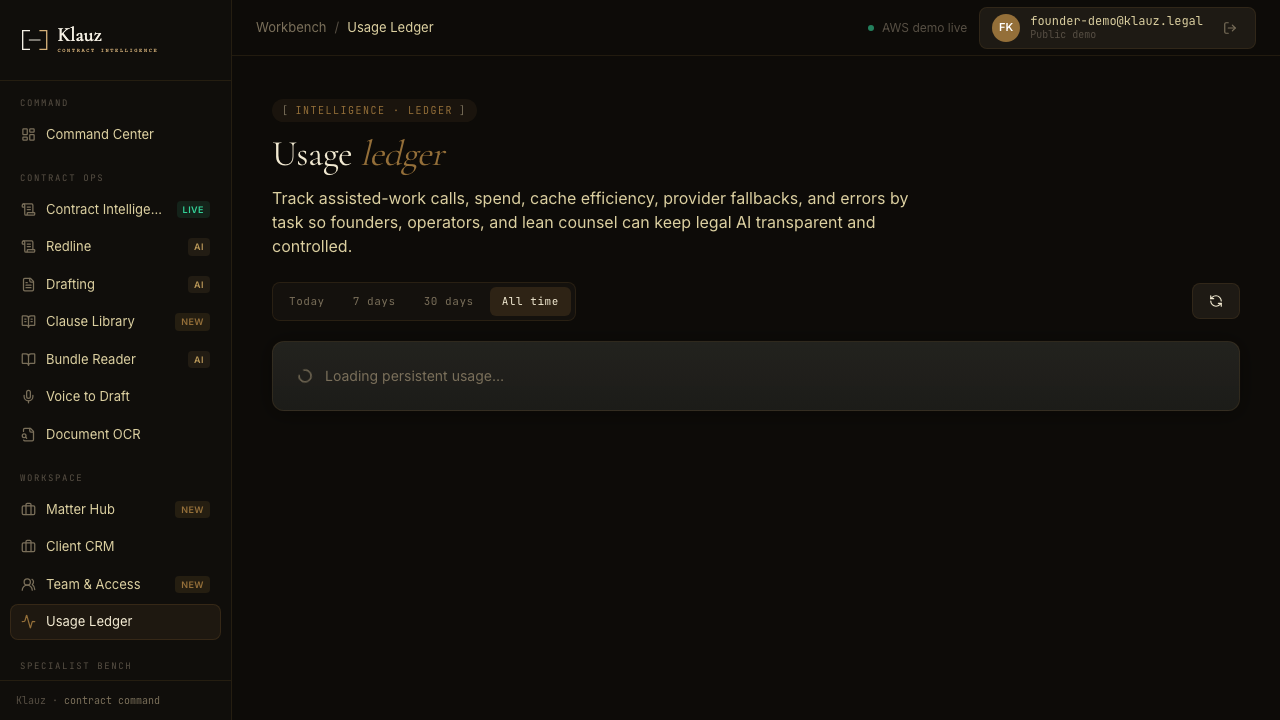
Every model call, every clause touched, every specialist minute is logged with the provider and the cost. Audit by construction. No invoice reconciliation the CFO cannot verify.
The drafting time on a vendor MSA went from a week to an afternoon. The savings went to actually negotiating the terms.
Operations lead · mid-market industrial company · India pilot
This is the whole product in one gesture. A risky clause is struck, the playbook fallback is written in its place, and the reason it was proposed is pinned to the margin. Watch it run, or step through each clause yourself.
Every lane is probed on every deploy and audited on every release. The deterministic safety net is always on so a lawyer never lands on a blank screen. Open the workbench →
Eight architectural pillars carry the workbench. Each one is a design decision made once, verified continuously, and audited by construction. The pillars are the reason a lean team closes more paper here than a procurement-heavy stack closes anywhere else.
Every reasoning call is routed to the smallest model that can carry the clause. Batch retrieval, deterministic prompts, and cached context keep the median call under a fraction of the naive cost. Throughput scales linearly with matter volume, not with model marketing.
A four-tier reasoning stack drops to the cheapest lane that meets the accuracy floor for the task. Deterministic templates handle the shape; the reasoning layer handles the judgement; specialists handle the exceptions. Gross margin holds above ninety percent at operator tier.
Stateless workbench, warm-pooled compute, region-local retrieval. Ten times the current matter volume changes a number in the dashboard, not the topology. A pilot that lands on Monday scales to the whole firm by Friday without a re-architecture.
Every matter is written to redundant stores in the region of origin. Point-in-time recovery to any minute of the last thirty days. Provider outages fall back to the next reasoning lane inside a single request; the reader never sees the seam.
Encryption at rest and in flight is the floor. Every request is scoped to a matter, every matter to a firm, every firm to a tenant. No cross-tenant retrieval. No customer data ever enters a training set. Rotation policy applies to every credential.
Data lives in the jurisdiction of the matter. Indian matters stay in Indian storage, US matters in US storage, EU matters in EU storage. The reasoning layer follows. A DPDP, PDPL, or GDPR request answers itself because the topology already respects the boundary.
The reasoning, retrieval, and drafting layers use the current generation of models at every tier. Upgrades ship inside a release, not a quarter. The workbench is the last surface the reader sees; behind it, the stack is refreshed to whatever is state of the art the week it lands.
The workbench runs on hardware chosen for cost per correct answer, not brand loyalty. Warm pools where latency matters. Batch pools where volume matters. Every deployment carries an explicit cost per thousand matters that the CFO can verify.
The eight pillars are audited on every release. Every pillar carries a probe in the admin design document, and every probe carries an ISO timestamp on its last pass. The workbench is the surface. The architecture is the reason it holds.
Open the workbench →Cover · Wedge · Product Spine · Reasoning Posture · Legal-Workflow Inheritance · Pricing · YZi Ask · Verification Receipts.
Five toys. Keyboard-first, deterministic, and quick to walk. Each one is a different shape of play built out of the same brass-on-cream glyph set the rest of the document reads in. Ninety seconds a round. No sign-in, no counter, no leaderboard. Just the game.
Reflex
Catch the brass glyphs before they exit the margin.
Precision
Race a steady baseline glyph for glyph.
Memory
Flip pairs of sigils. Fewer flips is the score.
Sequence
Tap the sigils in the order the seal implies.
Timing
Press when the bead crosses the brass rule.
Message +1 555-163-7561 on WhatsApp. Send /deck for this memo, /bail Rajesh Kumar, Bombay HC, BNS 318, first offender for a court-ready bail application, /help for the full menu.
Today the WhatsApp channel is verified-recipients-only via the Meta Cloud API test number. Full App Review plus Business Verification opens it to any counterparty. Use the workbench today →